& Construction

Integrated BIM tools, including Revit, AutoCAD, and Civil 3D
& Manufacturing

Professional CAD/CAM tools built on Inventor and AutoCAD
Sustainability has entered a new phase across Design and Make industries. What was once viewed primarily as a compliance requirement or corporate responsibility initiative is increasingly recognized as a source of competitive advantage and long-term business value. Today, 67% of organizations say sustainability creates a competitive advantage, while 71% believe sustainability initiatives can generate more than 5% of annual revenue over time. The conversation is shifting from why sustainability matters to how organizations create value from it.
As Julien Jean-Charland, national director of digital delivery at CIMA+, shares, "We don't just build the most efficient building—we build the one that's most comfortable for people. That's what differentiates us." Gabriele Gambotto, co-founder and CTO at Leva Engineering in Turin, Italy, makes a similar point, saying, "Of course, we want it to be sustainable because it's part of our values, but there are huge advantages of being completely electricity-driven." Sustainability is increasingly viewed not simply as an environmental commitment, but as a business strategy that delivers multiple benefits.
Execution, however, remains challenging. Forty-one percent of organizations say they are falling behind on their sustainability goals, even as confidence in sustainability's business impact continues to grow. The tension is no longer between sustainability and business value, but between ambition and execution.
of business leaders say sustainability has shifted from obligation to competitive advantage
of business leaders say sustainability initiatives can generate more than 5% of annual revenue
of pacesetters see sustainability as a competitive edge vs 64% of mainstream orgs
— Isabelle Spiegel, Vice President of Environment, VINCI, a global construction company based in Nanterre, France
Survey question: To the best of your knowledge, how much business value (as a percentage of annual revenue) can sustainability measures generate in the long term for your company? 5-point scale. Numbers do not add up to 100% due to rounding.
Organizations increasingly expect sustainability to contribute directly to financial performance. Nearly three in four believe sustainability initiatives can generate more than 5% of annual revenue, reinforcing the view that sustainability is becoming a source of business value rather than simply a cost of doing business.
Pacesetters are even more confident. Ninety-two percent say sustainability strengthens their competitive position; 94% view it as a long-term business advantage, and 89% expect sustainability initiatives to generate more than 5% of annual revenue.
The question is no longer whether sustainability creates value. Increasingly, organizations are focused on how to capture that value through better decisions, stronger operations, and connected digital capabilities.
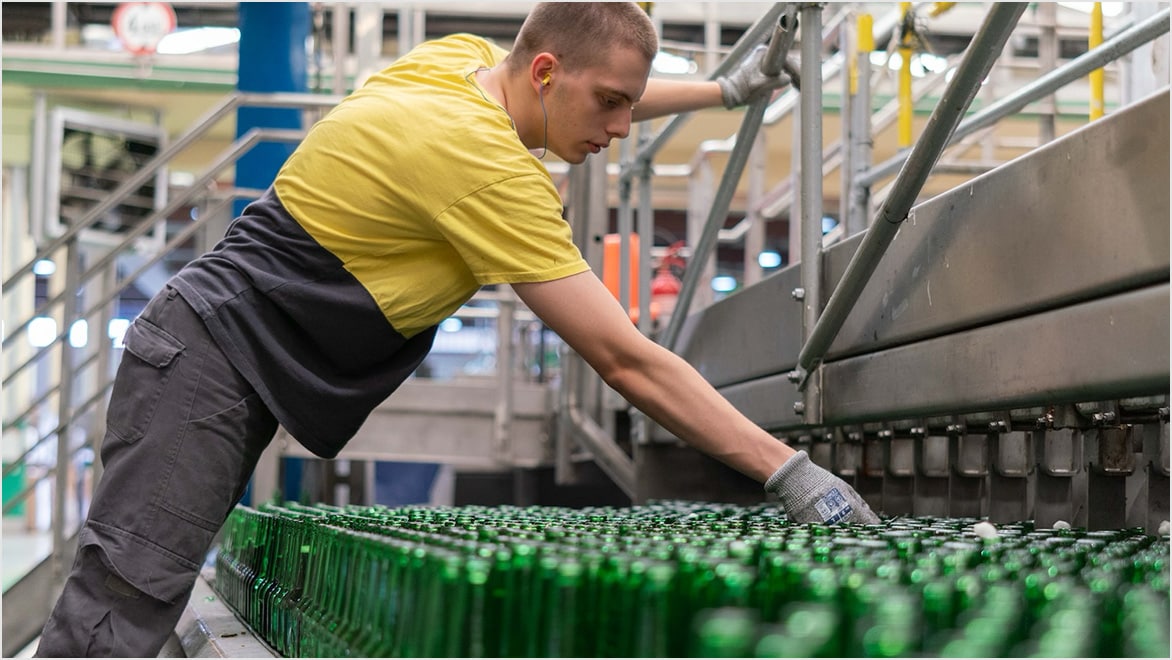
As Greece's largest brewery and a Heineken producer, Athenian Brewery set out to reduce emissions while improving operational performance. A digital view of energy use and production operations gave the company better visibility into equipment performance, maintenance needs, and resource consumption. Maintenance costs fell by up to 11%, while changeover times, energy use, water consumption, and CO₂ emissions each declined by 13%.
As with artificial intelligence (AI), Pacesetters don't simply invest more in sustainability. They build the organizational capabilities necessary to make sustainability part of everyday business decisions.
Compared with mainstream organizations, they are more likely to see sustainability as a competitive advantage (92% vs. 64%), expect sustainability initiatives to generate more than 5% of annual revenue (89% vs. 70%), and report strong internal motivation to achieve sustainability goals (94% vs. 68%).
Technology is one way Pacesetters put those commitments into practice. Compared with mainstream organizations, they are more likely to improve energy efficiency (42% vs. 35%), increase renewable energy use (38% vs. 29%), adopt circular design practices (38% vs. 29%), and use AI to advance sustainability initiatives (53% vs. 36%).
As Autodesk Chief Sustainability Officer, Joe Speicher, observes, “AI is particularly powerful at revealing trade-offs. It can help organizations evaluate cost, carbon, performance, and risk together—and make better decisions earlier, when they have the greatest impact.”
These findings reinforce a broader pattern throughout this report: Organizations create greater value when digital transformation, AI, and sustainability strengthen one another rather than operating as separate initiatives.
– Rafael Passos Valadares, Engineering Director, Grupo Direcional, Brazil
Survey question: What changes has your company or organization already made to be more sustainable? Percent selected, multiple answers possible. Note: Some answer options are shortened for better readability. Answer option “other” is not displayed. Mainstream and Pacesetter definitions.
Survey question: How much do you agree or disagree with the following statements about your company or organization? 5-point scale, top two= “somewhat agree” and “strongly agree.” Mainstream and Pacesetter definitions.
One finding stands out among the highest-performing organizations. Pacesetters are more likely than mainstream organizations to say they are falling behind on their sustainability goals—even while reporting stronger sustainability outcomes.
This apparent contradiction reflects a broader characteristic of high-performing organizations throughout this report. As organizations become more mature, they often raise their expectations faster than they declare success. Sustainability becomes less about completing individual initiatives and more about continually improving how decisions are made across the business.